icon QUBO

Universal solver for QUBO problems

Handle large-scale instances with ease

Get started
icon SDK

VeloxQ SDK

Production-ready Python interface to integrate QUBO optimization into real-world workflows

Get started
icon Drug Discovery

QUBO optimization in Drug Discovery

Apply QUBO-based optimization to R&D decisions today while staying ready for hybrid quantum-classical workflows

Get started
icon Logistics

Smarter logistics decisions, built for the quantum era

Quantum-ready optimization for modern logistics networks

Get started
icon Energy

Quantum-ready optimization for modern energy operations

Turn grid and asset complexity into faster, smarter operational decisions with quantum-ready product


Get started

Universal solver for QUBO problems

VeloxQ is a universal QUBO solver in the practical sense: it gives organizations one optimization engine for many different decision problems once they are expressed as QUBO (Quadratic Unconstrained Binary Optimization). That matters because routing, scheduling, allocation, portfolio optimization, and many other constraint-heavy tasks can share the same modeling and solving workflow instead of requiring separate tools for each use case.

This is especially valuable for quantum-readiness, because QUBO is also a common interface in quantum annealing and hybrid quantum-classical optimization. With VeloxQ, teams can start building real optimization pipelines today on conventional hardware, covering problem formulation, constraint design, benchmarking, and system integration, while keeping the same QUBO-based architecture ready for future hybrid quantum deployments.

From a product and engineering perspective, VeloxQ combines immediate usability with technical depth: organizations can deploy it now for production optimization, but also build reusable QUBO modeling patterns that improve over time across departments and sectors. In that sense, VeloxQ is not only a solver, because it is a practical bridge from classical optimization workflows to a quantum-ready operating model.

VeloxQ SDK

VeloxQ SDK is the Python interface for using VeloxQ in real optimization workflows, giving teams a practical way to submit QUBO/Ising problems, run them on selected backends, and retrieve structured results. In practice, it acts as the integration layer between your application or data pipeline and the VeloxQ platform, so you can move from experiments to production without changing the overall workflow model.

Using it is straightforward: install the SDK, set your API token (for example via the VELOX_TOKEN environment variable), create a VeloxQSolver, and submit a problem using solver.sample(...) for the fastest start. The SDK supports multiple input types—such as lists, NumPy arrays, sparse dictionaries, compatible model objects, and files. You can begin with a simple prototype or connect it to an existing optimization pipeline with minimal friction.

As your usage grows, the SDK also supports a more structured workflow built around Problems, Files, Solvers, and Jobs, including asynchronous execution, job monitoring, logs, and reusable uploaded instances. Results are returned as a VeloxSampleSet, which makes it easier to inspect solutions, compare energies, export data for analysis, and integrate optimization outputs into business systems, making the SDK both a quick-start tool and a production-ready interface for VeloxQ.

QUBO optimization in Drug Discovery

In drug discovery, many important steps involve combinatorial choices under constraints rather than only raw simulation. For example candidate prioritization, fragment or feature selection, docking pose ranking, assay planning, and multi-parameter hit triage.
VeloxQ can potentially support these stages by serving as a QUBO optimization engine that helps teams encode trade-offs such as potency proxies, selectivity, novelty, synthesizability, and resource limits into a structured optimization problem.
This makes it useful not as a replacement for chemistry or biology models, but as a decision-optimization layer that can improve how candidate options are selected and ranked.

A key advantage is that VeloxQ fits naturally into hybrid quantum-classical workflows, which are the most realistic adoption path for pharma and biotech teams. In practice, classical tools can continue to handle data preparation, molecular representation, scoring functions, simulation, and ML prediction, while VeloxQ is used to solve the combinatorial optimization subproblems that sit between those stages.
This allows organizations to modernize optimization-heavy parts of discovery pipelines now on conventional hardware, while keeping the same QUBO-based workflow design aligned with future quantum or hybrid execution models as they become more practical.

From a product and platform perspective, VeloxQ can also help standardize optimization across heterogeneous discovery programs by providing a common framework for repeated decision patterns across target discovery, hit identification, and lead optimization workflows.
Over time, teams can build reusable QUBO formulations, benchmark them across projects, and integrate outputs into existing computational chemistry and laboratory planning systems. In that sense, VeloxQ can be a practical bridge: delivering immediate operational value in drug discovery optimization while supporting long-term quantum-readiness without forcing disruptive infrastructure changes.

Smarter logistics decisions, built for the quantum era

In logistics, many high-value decisions are combinatorial and constraint-heavy, which makes them a strong fit for QUBO-style optimization: route planning, dispatching, delivery sequencing, fleet and driver assignment, warehouse task scheduling, load consolidation, cross-dock coordination, inventory positioning, and network design can all be framed as optimization problems with competing objectives (cost, time, capacity, service level, and resilience). VeloxQ’s positioning as a fast QUBO solver for real-world optimization makes it a useful candidate for these decision layers, especially when organizations want one optimization framework that can be reused across multiple logistics workflows.

A practical advantage is that VeloxQ fits naturally into hybrid quantum-classical workflows, which are often the most realistic deployment model for logistics. In this setup, classical systems continue to handle forecasting, ERP/WMS/TMS integration, data preparation, rule enforcement, and simulation, while VeloxQ is used for the optimization subproblems where binary decisions and trade-offs are hardest to solve efficiently. This lets organizations modernize optimization-heavy stages now on conventional infrastructure, while preserving a QUBO-based workflow architecture that can later be extended to selected quantum or hybrid execution paths as they become operationally beneficial.

From a product and operations perspective, VeloxQ can also support a broader logistics optimization strategy by helping teams standardize how they formulate, benchmark, and deploy decision models across different business units and use cases. Over time, organizations can build reusable QUBO formulations for recurring patterns (assignment, scheduling, capacity balancing, sequencing, disruption recovery), compare performance consistently, and integrate outputs into existing planning and execution systems. In that sense, VeloxQ can be used not only as a solver for individual tasks, but as a scalable optimization layer that supports both immediate operational gains and long-term quantum readiness.

Quantum-ready optimization for modern energy operations

Energy systems are full of interconnected optimization decisions that must be made under tight technical and economic constraints, which makes them a strong fit for QUBO-based approaches.
VeloxQ can potentially support use cases across generation scheduling, unit commitment, dispatch planning, storage charge/discharge scheduling, demand-response orchestration, maintenance planning, outage recovery, microgrid coordination, and network configuration, esp. where operators need to balance cost, reliability, resilience, and emissions at the same time.

A key advantage is that VeloxQ can be used as an optimization layer inside hybrid quantum-classical workflows rather than as a replacement for existing energy software. In practice, forecasting, simulation, SCADA/EMS integration, market inputs, and operational rule handling can remain in classical systems, while VeloxQ is used for the combinatorial decision stages where constraints and trade-offs become hardest to solve efficiently. This allows utilities, grid operators, and energy companies to improve optimization-heavy workflows now on conventional hardware while keeping the same problem architecture aligned with future quantum-enabled execution paths.

From a product and deployment perspective, VeloxQ can also help standardize optimization across heterogeneous energy operations, where teams often manage separate tools for planning, grid operations, distributed resources, and asset management. By using a common QUBO-based framework, organizations can reuse modeling patterns for recurring decisions (assignment, scheduling, balancing, contingency response), benchmark performance consistently across use cases, and integrate outputs into existing operational systems.

In that sense, VeloxQ can support both immediate operational improvements and a longer-term quantum-readiness strategy without requiring disruptive infrastructure changes.
Physics-inspired → Hybrid ▪ From Classical to Quantum ▪ Solve Variety of Optimization Problems ▪ Quantum-Accelerated ▪ Physics-Inspired ▪ Optimizing the Future ▪ Optimization Reimagined ▪ Classical to Quantum ▪ Physics-Driven Innovation Physics-inspired → Hybrid ▪ From Classical to Quantum ▪ Solve Variety of Optimization Problems ▪ Quantum-Accelerated ▪ Physics-Inspired ▪ Optimizing the Future ▪ Optimization Reimagined ▪ Classical to Quantum ▪ Physics-Driven Innovation Physics-inspired → Hybrid ▪ From Classical to Quantum ▪ Solve Variety of Optimization Problems ▪ Quantum-Accelerated ▪ Physics-Inspired ▪ Optimizing the Future ▪ Optimization Reimagined ▪ Classical to Quantum ▪ Physics-Driven Innovation Physics-inspired → Hybrid ▪ From Classical to Quantum ▪ Solve Variety of Optimization Problems ▪ Quantum-Accelerated ▪ Physics-Inspired ▪ Optimizing the Future ▪ Optimization Reimagined ▪ Classical to Quantum ▪ Physics-Driven Innovation Physics-inspired → Hybrid ▪ From Classical to Quantum ▪ Solve Variety of Optimization Problems ▪ Quantum-Accelerated ▪ Physics-Inspired ▪ Optimizing the Future ▪ Optimization Reimagined ▪ Classical to Quantum ▪ Physics-Driven Innovation Physics-inspired → Hybrid ▪ From Classical to Quantum ▪ Solve Variety of Optimization Problems ▪ Quantum-Accelerated ▪ Physics-Inspired ▪ Optimizing the Future ▪ Optimization Reimagined ▪ Classical to Quantum ▪ Physics-Driven Innovation Physics-inspired → Hybrid ▪ From Classical to Quantum ▪ Solve Variety of Optimization Problems ▪ Quantum-Accelerated ▪ Physics-Inspired ▪ Optimizing the Future ▪ Optimization Reimagined ▪ Classical to Quantum ▪ Physics-Driven Innovation Physics-inspired → Hybrid ▪ From Classical to Quantum ▪ Solve Variety of Optimization Problems ▪ Quantum-Accelerated ▪ Physics-Inspired ▪ Optimizing the Future ▪ Optimization Reimagined ▪ Classical to Quantum ▪ Physics-Driven Innovation Physics-inspired → Hybrid ▪ From Classical to Quantum ▪ Solve Variety of Optimization Problems ▪ Quantum-Accelerated ▪ Physics-Inspired ▪ Optimizing the Future ▪ Optimization Reimagined ▪ Classical to Quantum ▪ Physics-Driven Innovation Physics-inspired → Hybrid ▪ From Classical to Quantum ▪ Solve Variety of Optimization Problems ▪ Quantum-Accelerated ▪ Physics-Inspired ▪ Optimizing the Future ▪ Optimization Reimagined ▪ Classical to Quantum ▪ Physics-Driven Innovation

Our Process

  • 1. Classical Computing

    We bridge the gap between classical and quantum computing

    We bridge the gap between classical computing paradigms of today and the future fault tolerant architectures in the coming years.

  • 2. Phisics-inspired

    We effectively explore and exploit solutions

    We develop algorithms inspired by physics, based on physical phenomena. This enables us to use for example GPUs or different hardware to tackle problems that are challenging or unsolvable with classical solvers or existing quantum computers.

    Moreover, the way we represent these problems remains compatible with future quantum computers, regardless of their technological advancements.

  • 3. Hybrid

    We are hybrid in nature

    We envision the future of computing as a hybrid of classical and quantum systems, where complex problems are divided and processed separately by nature-inspired algorithms for enhanced speed and precision.

    This approach allows for tackling larger and more intricate challenges, capitalizing on the strengths of both computing paradigms.

  • 4. Quantum

    Quantum-ready today

    While fault-tolerant quantum computing architectures are still years away, it is crucial to begin developing transitions and integrations now to pave the way for future quantum products.

    Our approach is hardware-agnostic, ensuring that we remain independent of any specific quantum hardware. This allows us to seamlessly integrate with various technologies and stay adaptable to advancements in the field.

Jobs and outputs

Access through the UI, REST API or SDK
Technical Features

Quantum and physics-inspired solvers are essential for tackling complex optimization problems encoded as Quadratic Unconstrained Binary Optimization. Vital in finance, logistics, and scheduling, they can provide quick and efficient solutions. Leveraging advanced algorithms and quantum computing, our QUBO solver handles large-scale problems where traditional methods lack efficiency, significantly enhancing performance and outcomes.

QUBO Solver

Our cutting-edge solver handles combinatorial optimization problems with tens of millions of variables, making it ideal for complex, large-scale challenges. It efficiently manages fully connected graphs and operates independently of any specific qubit topology, ensuring maximum flexibility and performance. This advanced technology seamlessly integrates into various applications, delivering effective solutions for even the most intricate optimization tasks. Trust our solver to revolutionize your problem-solving capabilities with unmatched efficiency and precision.

Tens of millions of variables

Our hybrid approach leverages a diverse range of computational resources, including CPUs, GPUs, and QPUs, as well as TPUs, FPGAs, and ASICs, to significantly boost performance. By utilizing the strengths of each type of processor, we ensure that our solutions are both powerful and efficient. We maintain an agnostic stance regarding quantum device providers, allowing us to integrate seamlessly with various technologies and platforms. This flexibility ensures that we can always utilize the best available resources to deliver optimal performance for your computational needs.

Hardware accelerated

We provide a comprehensive REST API that allows users to tweak the solver, send jobs, and manage the optimization problems they are solving. With our REST API, users can easily integrate our powerful solver into their workflows, customize parameters, and efficiently handle a wide range of optimization tasks. Detailed documentation ensures a smooth user experience, enabling quick implementation and effective problem management.

Rest API

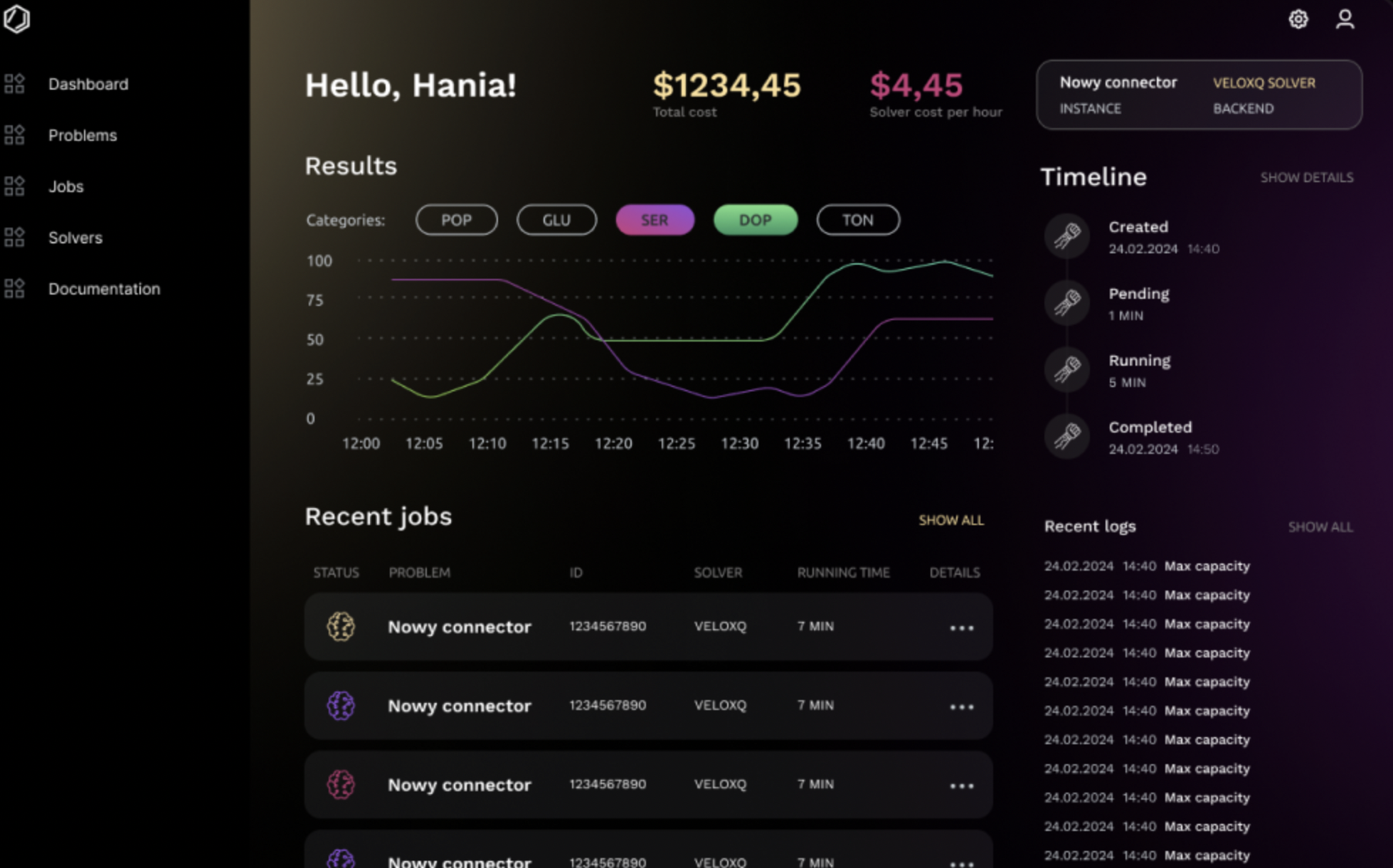
Our veloxQ UI is a web-based interface designed for users who want to test and try the solver. Accessible through any modern web browser, this intuitive interface allows users to easily interact with and evaluate our powerful optimization solutions. Within the UI, users can view different backend options, compare prices for solvers, manage their optimization problems, and see detailed charts of their results. Whether you are tweaking parameters, sending jobs, or analyzing outcomes, the veloxQ UI provides a seamless and efficient user experience.

VeloxQ User Interface

We provide a certified quantum randomness source that can be used as a seed within our solvers, ensuring the highest level of unpredictability and security for your computations. This feature enhances the reliability and robustness of our optimization solutions across the platform, offering an additional layer of precision and integrity for all your optimization tasks.

Quantum Randomness

Our solver is designed for high parallelism, enabling it to run on multiple instances of GPUs, particularly in HPC (High-Performance Computing) environments. This highly parallelizable approach empowers the solver to tackle large-scale problems efficiently, distributing the computational load and significantly accelerating the optimization process. With this capability, our solver can handle the most demanding tasks, delivering fast and reliable solutions.

Highly parallelizable

We leverage the sensitive nature of nonlinear dynamical systems, where small parameter tweaks can cause large state changes, to solve optimization problems efficiently. By applying physics-inspired algorithms, we effectively explore and exploit these shifts in the solution space, quickly finding optimal or near-optimal solutions, especially in cases where traditional methods falter due to complexity.

Physics-Inspired

Quantum computing involves probabilistic results for large-scale data. Classical computers can manage the overall workflow (pre-processing, decomposition, mid-processing, post-processing) of the quantum-derived results. They can also handle tasks requiring deterministic processing and high precision. This division of workloads allows for more efficient problem-solving, combining the quantum computer's speed in certain calculations with the classical computer's versatility and accuracy.

Hybrid approach

QUBO models are ideal for quantum-readiness, as they seamlessly align with the capabilities of quantum computers. These models can utilize quantum computing's parallel processing strength. This compatibility positions QUBO as a key tool for transitioning into the era of quantum computing, particularly in optimization-intensive sectors. Our algorithms use QUBO models also on classical architecture to allow for seamless transition.

Quantum-ready

QUBO Solver

Tens of millions of variables

Hardware accelerated

Rest API

VeloxQ User Interface

Quantum Randomness

Highly parallelizable

Physics-Inspired

Hybrid approach

Quantum-ready

Get Quote
Meet our expert ▪ Get to know our specialist ▪ Say hello to our expert ▪ Discover our professional ▪ Spotlight on our expert Meet our expert ▪ Get to know our specialist ▪ Say hello to our expert ▪ Discover our professional ▪ Spotlight on our expert Meet our expert ▪ Get to know our specialist ▪ Say hello to our expert ▪ Discover our professional ▪ Spotlight on our expert Meet our expert ▪ Get to know our specialist ▪ Say hello to our expert ▪ Discover our professional ▪ Spotlight on our expert Meet our expert ▪ Get to know our specialist ▪ Say hello to our expert ▪ Discover our professional ▪ Spotlight on our expert Meet our expert ▪ Get to know our specialist ▪ Say hello to our expert ▪ Discover our professional ▪ Spotlight on our expert Meet our expert ▪ Get to know our specialist ▪ Say hello to our expert ▪ Discover our professional ▪ Spotlight on our expert Meet our expert ▪ Get to know our specialist ▪ Say hello to our expert ▪ Discover our professional ▪ Spotlight on our expert Meet our expert ▪ Get to know our specialist ▪ Say hello to our expert ▪ Discover our professional ▪ Spotlight on our expert Meet our expert ▪ Get to know our specialist ▪ Say hello to our expert ▪ Discover our professional ▪ Spotlight on our expert

Any questions?
Just ask our expert

Let’s talk

Pricing

Pay as you want

Easy

Usage-based billing per hour

Prepaid

Best for individuals who want to test our solution and experience its benefits firsthand

VeloxQ solver with unlimited problem size
Unlimited daily jobs
100 GB of free storage
Cloud backends

Pro

one flat fee

Contact us

Best for businesses that need scalable, and secure, solutions to meet complex organizational demands

Everything from „Pre-paid”
Unlimited storage
Highest priority jobs
On premise high-end backends
Individual technical support
Access to additional algorithms
Exclusive and early-access backends
Early access to new features and algorithms
Contact us